


Austin’s latest round of city development news has once again placed Project Connect’s light rail at the center of public attention. As a transformative infrastructure effort with a projected investment of $8.23 billion, the project is finally moving from long-term planning into tangible action. According to the Austin Transit Partnership (ATP), the three core contracts that will define the first phase of the system are all scheduled to be awarded in 2026.
Recent updates also revealed a meaningful milestone: the light rail has received a “Medium-High” rating from the Federal Transit Administration, significantly strengthening Austin’s eligibility for federal funding.
As the updated alignment becomes clearer, the corridor stretching through Downtown Austin, the UT campus, South Congress, and Riverside is emerging as one of the most important development arteries for the next decade. The long-term infrastructure value it unlocks is already beginning to influence how surrounding land and future redevelopment potential are being assessed.
 (Project Connect renderings)
Project Updates: Contracts, Timeline, and Funding
In its latest briefing, ATP provided a detailed look at the timeline ahead. The three major components of the light rail, the 9.8-mile main line, the O&M facility near US-183 and SH-71, and the procurement of rail vehicles, will all be contracted out during 2026.
Despite the absence of visible ground activity today, ATP reaffirmed that the overall schedule remains intact: construction is slated to begin in 2027, with the initial segment expected to be completed in 2033.
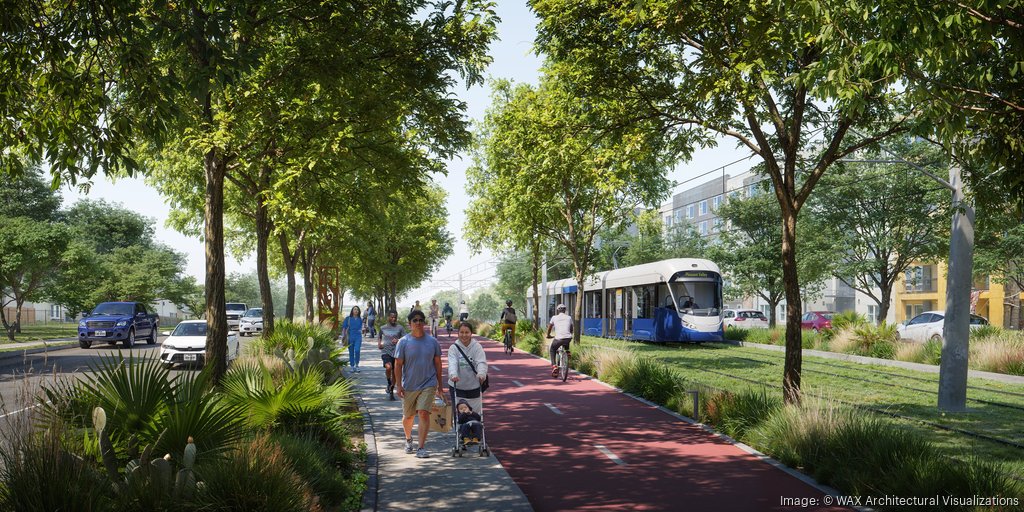 (An artist’s conceptual visualization of the light rail system)
Perhaps the most encouraging development for both planners and investors is ATP’s “Medium-High” FTA rating. This positions the project to secure nearly half of its capital and financing costs through federal funding—an essential component for advancing a project of this scale.
The FTA also noted that the corridor is highly developed today, with only 3% of land within a half-mile currently undeveloped, meaning most future development will come from redevelopment and increased density, particularly in areas of South Austin where zoning allows for upzoning.
Citywide Impact: Density, Connectivity, and Redevelopment
According to the latest released alignment, Austin’s first light rail line will run through the city’s highest-activity zones: Downtown, South Congress, Riverside, UT, 38th Street, Koenig/Crestview, and East Austin. Over the next decade, this stretch is expected to evolve into Austin’s most significant transit-oriented development (TOD) corridor, supporting higher land utilization, improved mobility options, stronger clustering of employment centers, and large-scale redevelopment around station areas.
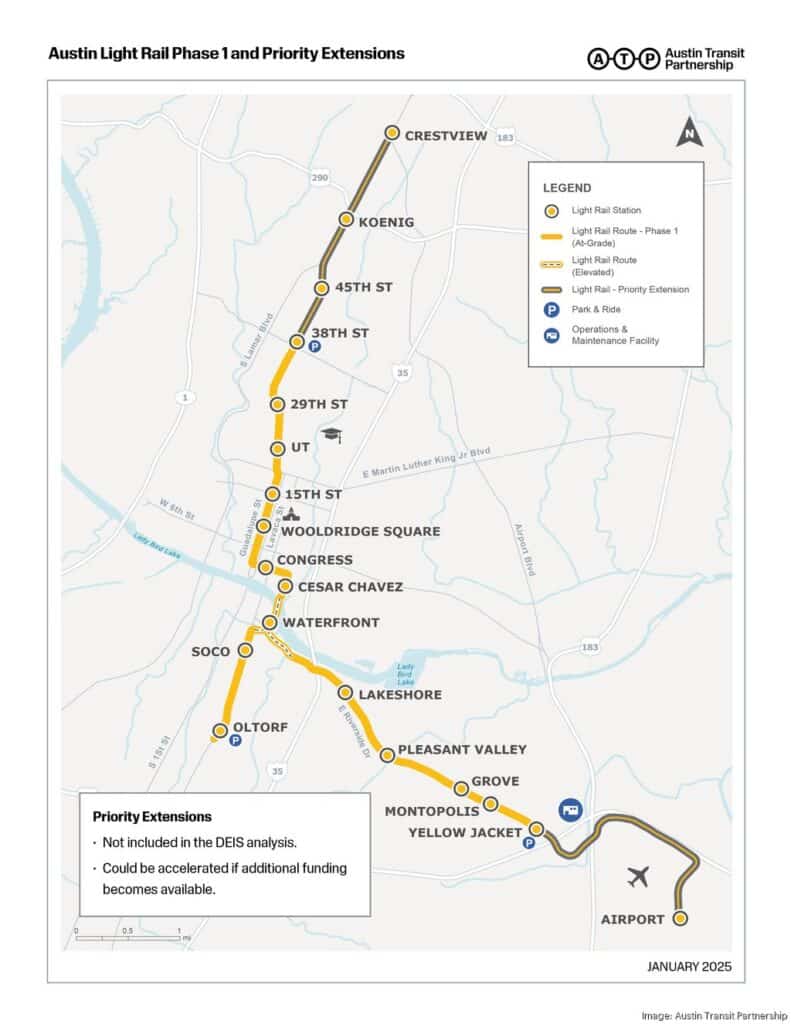 (The map of the tweaked light rail route)
Although Phase One will not yet extend to Austin–Bergstrom International Airport, ATP has confirmed that design coordination and preliminary engineering work with ABIA are already underway. If additional funding becomes available, the airport extension is positioned to advance quickly, supported by early-stage design already in progress.
Overall, Project Connect is expected to generate more than 7,000 construction jobs and around 1,000 permanent operations jobs, while improving access to employment centers representing roughly 200,000 jobs. As one of Austin’s largest public infrastructure investments, the project is poised to reshape the city’s mobility network and support long-term real estate value growth along the corridor.
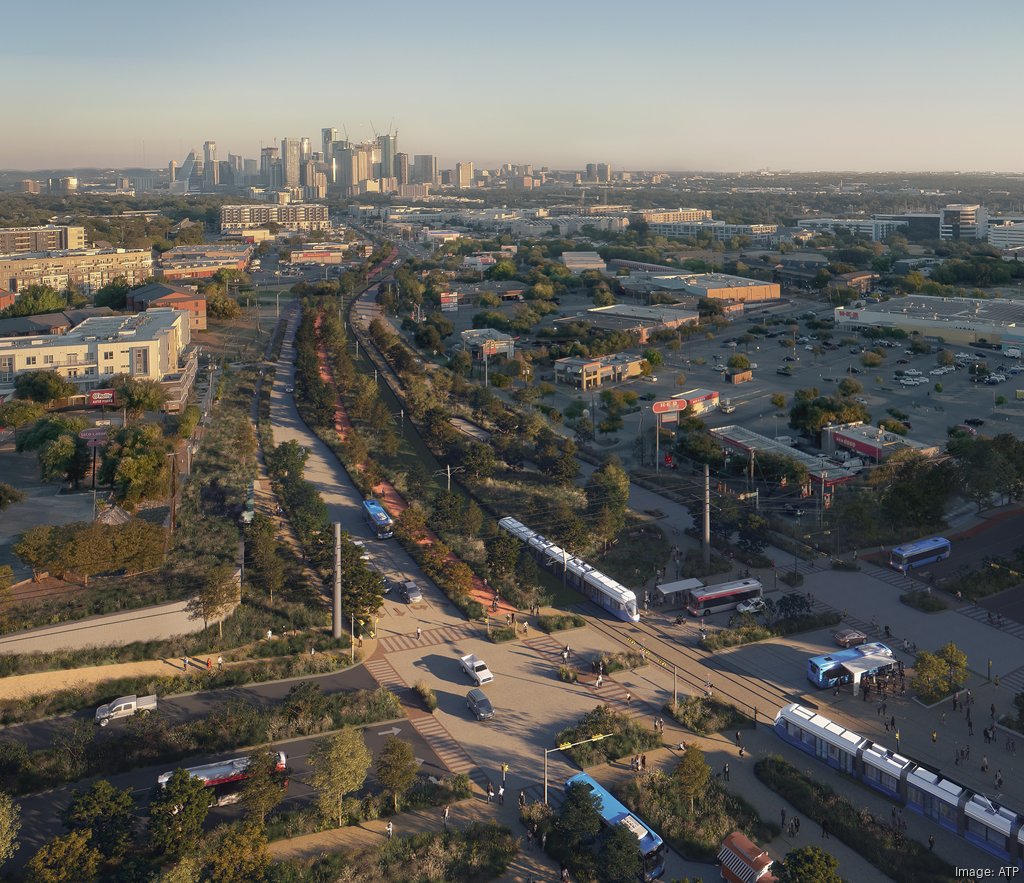 (An artist’s conceptual visualization of the light rail system.)
Exclusive Opportunity Along the Light Rail Corridor
With a project of this scale reshaping expectations across the city, one question naturally follows: Are there investment opportunities emerging alongside this major urban infrastructure project?
The answer is yes.
Real International is currently offering an exclusive opportunity: the Crystal-line project, located just off the planned light rail alignment. Beyond benefiting from the long-term uplift associated with Project Connect, the site also sits within an officially designated Opportunity Zone (QOZ), a combination that has become increasingly rare in Austin’s urban core.
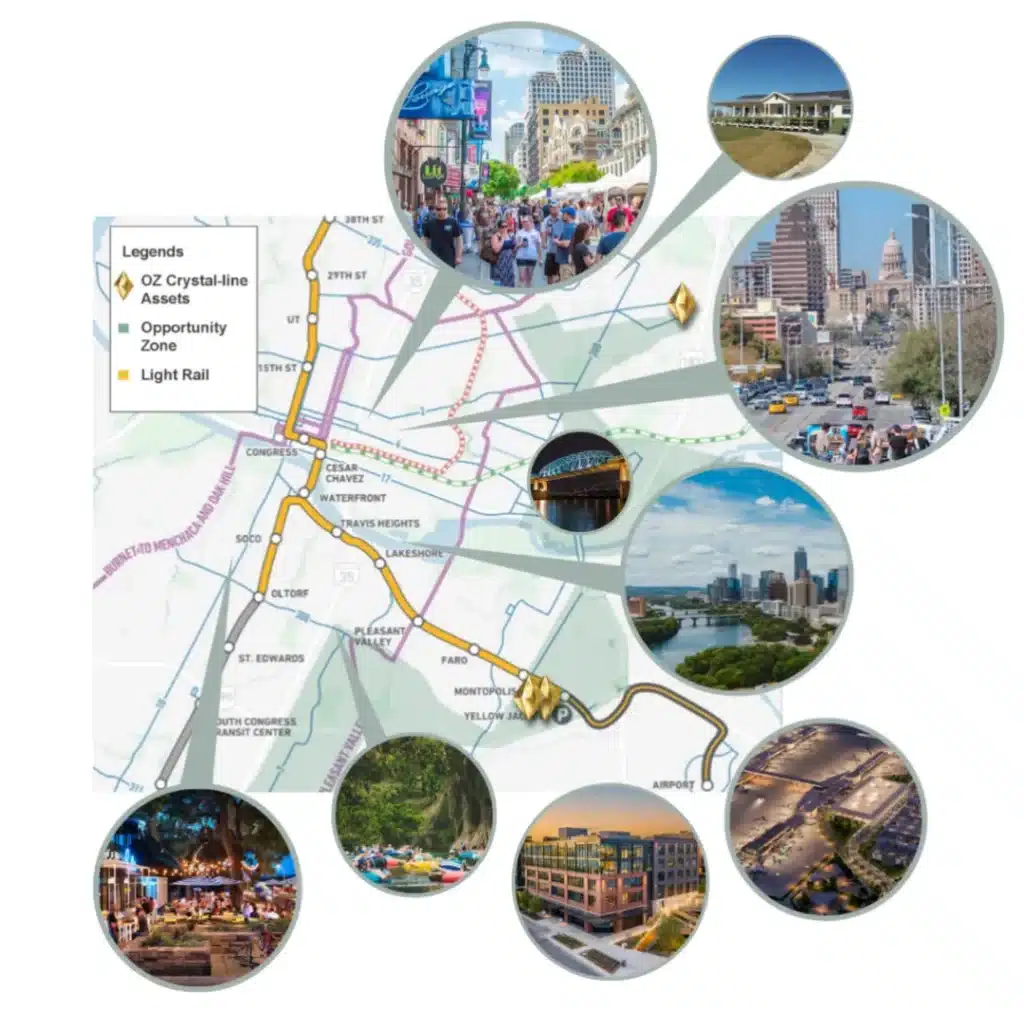
( Crystal-line project location)
Crystal-line Project Highlights
🚉 Close to future light rail: Within walking distance of a planned Project Connect station
📍 Prime East Austin location: One of the few remaining central areas still classified as an Opportunity Zone
💸 Tax deferral: Capital gains from real estate, stocks, or business sales can be deferred through a Qualified Opportunity Fund
🆓 10-year tax exclusion: Hold the investment for 10+ years and pay zero federal capital gains tax on appreciation
🏙 High-growth planning district: Surrounding area includes mixed-use redevelopment, higher density zoning, and strong urban regeneration momentum
The combination of light rail adjacency plus Opportunity Zone tax advantages positions Crystal-line as more than a strong site. It is one of the very few opportunities capable of offering both long-term growth potential and powerful tax efficiency, a pairing that is becoming increasingly scarce in today’s Austin market.
Spots are limited, so if you’re looking to take advantage of this unique dual benefit, don’t hesitate to contact us!