A guide to understanding how commercial real estate can serve as a tool for long-term growth, income, and tax-efficient wealth building.
Most high-net-worth portfolios are structured around liquidity and familiarity - not necessarily for long-term performance. The research tells a striking story.
Those numbers come from the Capgemini World Wealth Report - a global survey of over 23 million high-net-worth individuals. A quarter of their wealth is in cash, eroding to inflation. Another third is in public stocks and bonds - assets the owner can watch go up and down, but cannot influence.
Meanwhile, Knight Frank's survey of 150 family offices found that 44% plan to increase their real estate allocation in the next 18 months. These are families managing hundreds of millions. They've seen what real estate does across decades.
The question isn't whether real estate belongs in a long-term wealth strategy. The question is what kind of real estate - and how to get there efficiently.
In the world of commercial real estate investing, there are two fundamental approaches - each designed for a different objective and a different role in a long-term wealth strategy.
A portfolio has two jobs: grow wealth and protect wealth. Most investors need both. The question is how much of each - and that's a conversation for you and your financial advisor.
Equity investing means owning the property - directly or through a fund or partnership. The investor participates in the upside: rental income, appreciation, and long-term value creation. This approach is for capital that can afford to be patient.

Debt investing means lending against property rather than owning it. The investor earns interest income from a secured position - typically backed by a first lien on the real estate. This approach prioritizes current income and downside protection.
Many experienced investors use both approaches - equity for growth and debt for income. The right balance depends on your circumstances. A qualified financial advisor can help you determine what makes sense.
| Real Estate Equity | Real Estate Debt | |
|---|---|---|
| Primary Objective | Long-term capital appreciation | Current income & capital preservation |
| Capital Stack | Ownership position - last to be repaid | Senior lien - first to be repaid |
| Income Type | Distributions from rental income + sale proceeds | Interest payments from borrowers |
| Typical Duration | 3-7+ years | 1-3 years (shorter duration) |
| Risk / Return | Higher potential return, higher risk | Lower return potential, lower risk |
| Best Suited For | Patient capital seeking growth | Capital seeking steady income & protection |
Every investor is different. But the questions are remarkably consistent. Here are four common situations where people begin exploring commercial real estate - and the kinds of questions they bring to their advisors.
You spent years building a company. You sold it. Now you're sitting on significant capital in a brokerage account earning 4%. You know that's not enough - but you also don't want to hand control to the stock market.
How might real estate equity strategies - acquiring and improving tangible assets - serve as a natural next chapter? Could real estate debt provide current income while equity positions grow? If the sale generated capital gains, are there tax-deferral mechanisms worth exploring with a CPA? These are common starting points for a conversation with a qualified financial advisor.

Between two 401(k)s and IRAs, you've accumulated over $2 million. But it's all stocks, bonds, and mutual funds. You've watched balances drop 20-30% in bad years. As retirement approaches, you're not sure you can afford another drawdown.
Could a self-directed IRA provide access to real estate debt - a position secured by physical property and less correlated to public markets? What are the SDIRA rules and custodian requirements? These are questions for a qualified financial advisor and SDIRA custodian.

You own rental properties. They've served you well. But the management burden is real, and if you sell, you face a significant tax bill from depreciation recapture and capital gains.
Could a 1031 exchange allow you to defer the tax bill by reinvesting into institutional-quality real estate equity - professionally managed, no landlord duties? Could a Delaware Statutory Trust qualify as passive replacement property? Does the step-up in basis at death potentially eliminate deferred gains permanently? These are questions for a qualified intermediary, CPA, and estate attorney.

You're not thinking about this year's returns. You're thinking about what your family looks like in thirty years. You want wealth that grows, endures, and transfers cleanly.
How might a combination of real estate equity and real estate debt work inside a family wealth structure? Could Family Limited Partnerships transfer interests at a discount? Does the step-up in basis, combined with 1031 deferral, create a generational compounding cycle? These are questions for an estate attorney, CPA, and financial advisor.

The tax code provides several well-established mechanisms that may allow investors to transition existing assets into commercial real estate. Here is a general overview.
Capital gains from stock sales may be invested in a Qualified Opportunity Fund within 180 days to defer the tax, with potential permanent exclusion of new gains after a ten-year hold. Charitable vehicles (CRTs, DAFs) may allow gains to be bypassed entirely. Consult your tax advisor.
A tax-free rollover to a self-directed IRA or Solo 401(k) may allow retirement capital to invest in commercial real estate - equity or debt positions. Growth compounds tax-deferred (Traditional) or potentially tax-free (Roth). Consult your financial advisor and SDIRA custodian.
A 1031 exchange may defer 100% of capital gains and depreciation recapture. DSTs may qualify as passive replacement properties. Under current law, chained exchanges combined with step-up in basis at death can potentially eliminate deferred gains permanently. Consult your QI and tax advisor.
Business sale capital gains may qualify for OZ deferral with potential permanent exclusion. Installment sales under IRC §453 may spread recognition across years. Congress permanently extended the OZ program in 2025. Consult your tax advisor.
The simplest path. Deploying cash into commercial real estate is generally not itself a taxable event. No exchange mechanics, no deadlines. For many investors, this is where the relationship with commercial real estate begins.
FLPs may allow the transfer of real estate interests to heirs at discounted values. Under current law, the $15M per person estate exemption is permanent. Combined with step-up in basis, real estate may be among the most tax-efficient assets to hold across generations. Consult your estate attorney.
These strategies aren't new. They've been used by the wealthiest families in America for generations. Here's why commercial real estate has historically compounded differently.
Rental income is generally passive and typically not subject to the 15.3% self-employment tax. Depreciation - especially with 100% bonus depreciation now permanent - may further reduce the taxable portion. The result: real distributions with a lower taxable figure. Consult your CPA.
A 1031 exchange may defer 100% of capital gains by reinvesting into replacement property. This can potentially be done repeatedly - each time resetting the depreciation clock while carrying forward the deferred gain.
Under current law, when real estate passes to heirs at death, the cost basis is "stepped up" to fair market value. Every dollar of gain - including gains deferred through 1031 exchanges - may be permanently eliminated. This is the mechanism that has made real estate the foundation of multi-generational wealth for many American families.
Income that may be tax-sheltered. Growth that may be tax-deferred. A legacy where accumulated gains may be permanently eliminated. This isn't a loophole - it's how Congress designed the tax code to encourage long-term private investment in real property.
Real International Realty is a commercial real estate operating company headquartered in Austin, Texas. We acquire, improve, and manage commercial properties, and we originate and service commercial real estate loans.
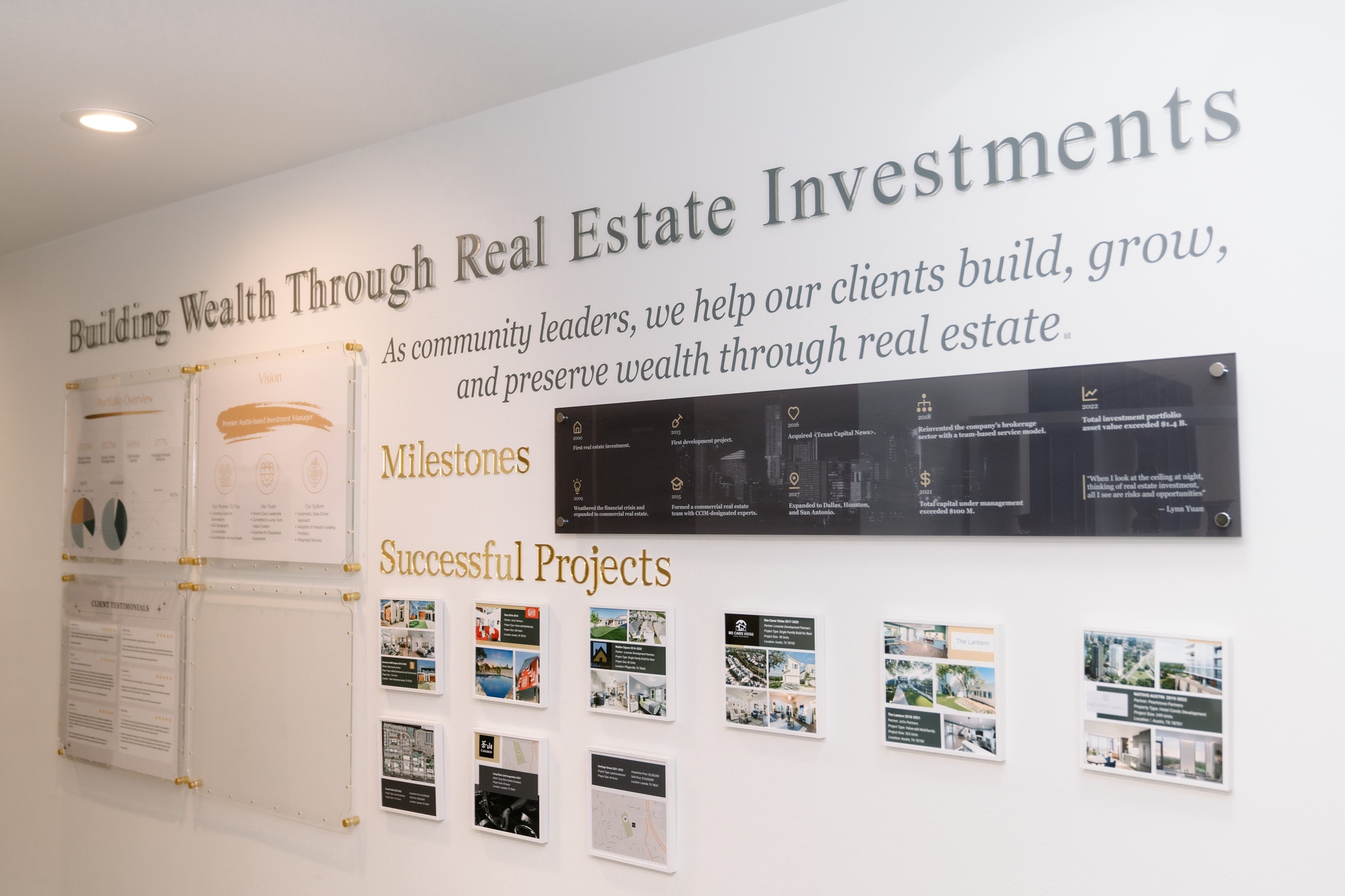
Our team operates across the full lifecycle of commercial real estate - from identifying and acquiring properties, through renovation and asset management, to disposition. On the lending side, we originate and manage senior secured loans backed by commercial real estate. We are hands-on operators with direct experience in the markets and asset types we focus on.
We work with individuals, families, and family offices who are interested in understanding how commercial real estate works - as an asset class, as a long-term wealth strategy, and as a practical investment. We're happy to share what we know about the market, our experience as operators, and the kinds of dynamics we see in the industry.
We want to be direct about this: Real International does not provide investment advice, tax advice, legal advice, or financial planning of any kind. We are real estate operators, not advisors. We don't hold ourselves out as RIAs, broker-dealers, CPAs, or attorneys - because we aren't any of those things. Any decision about whether and how to invest in commercial real estate should be made in close consultation with your own qualified CPA, attorney, financial planner, and/or registered investment advisor.

Whether you're exploring commercial real estate for the first time or looking to deepen your understanding, we have two ways to stay connected.
Schedule a no-obligation call with our team to discuss the commercial real estate market and how operators like us think about it.
Schedule a CallJoin our monthly market insights list for educational content on commercial real estate trends, strategies, and market updates.
Join the ListReaching out or subscribing does not create any advisory relationship, obligation, or commitment. This is not a solicitation or offer to sell any securities. Any investment opportunity would only be presented through definitive offering documents to qualified investors who meet applicable legal requirements. You may unsubscribe from the insights list at any time.
This guide is published by Real International Realty ("Real International," "RI," or "the Company") solely for general informational and educational purposes. It is not intended to be - and should not be relied upon as - a comprehensive or complete analysis of any topic discussed herein.
Real International Realty is a commercial real estate operating company. It is not a registered investment adviser (RIA) under the Investment Advisers Act of 1940 or any state law. It is not a broker-dealer registered under the Securities Exchange Act of 1934 or with any state securities regulator. It is not a CPA, tax preparer, enrolled agent, attorney, law firm, financial planner, CFP, or fiduciary of any kind. Real International does not hold itself out as any of the foregoing and is not registered with the SEC, FINRA, any state securities or insurance regulator, or any other regulatory body in any advisory, broker-dealer, or professional capacity.
Nothing in this guide constitutes - or should be construed as - investment advice, tax advice, legal advice, accounting advice, financial planning advice, estate planning advice, retirement planning advice, or any other form of professional advice or recommendation. Real International expressly disclaims any intention to provide any such advice.
All readers are strongly urged to consult with their own independent, qualified professionals before making any investment, financial, tax, legal, or estate planning decision. This includes a registered investment adviser or qualified financial planner; a CPA or qualified tax advisor; an attorney specializing in securities, real estate, or estate planning; and any other relevant professional.
This guide does not constitute an offer to sell, or a solicitation of an offer to buy, any security, investment product, fund interest, or other financial instrument. No such offer or solicitation is being made. Any offer to sell securities may only be made pursuant to definitive offering documents containing complete terms, conditions, and risk factors. No money or other consideration is being solicited by this guide.
Receipt of this guide, or any communication with Real International regarding the topics discussed herein, does not create an advisory, fiduciary, client, or other professional relationship between the reader and Real International.
This guide contains forward-looking statements based on current expectations and assumptions subject to risks and uncertainties. Forward-looking statements are not guarantees of future performance. Actual results may differ materially. All projections and illustrations are hypothetical and for educational purposes only.
Investments in commercial real estate involve significant risks including complete loss of capital, illiquidity, absence of secondary markets, market and interest rate risks, regulatory changes, tenant risks, leverage risks, and general business risks. Past performance does not guarantee future results.
Tax laws are complex, change frequently, and are subject to differing interpretations. Descriptions of tax concepts herein reflect the Company's general, non-professional understanding of current federal law as of 2026. Real International does not warrant, represent, or guarantee the accuracy of any tax information or the tax treatment of any strategy or transaction. State and local tax treatment may differ materially.
Potential tax benefits described are not guaranteed. They depend on individual facts, applicable law, and proper compliance with all rules and deadlines. Failure to comply may result in full taxation and additional penalties.
All investor profiles, scenarios, and illustrations are purely hypothetical composites for educational purposes. They do not represent any specific individual, any client of Real International, or any investment outcome.
Market data is sourced from publicly available reports including Capgemini World Wealth Report 2025 and Knight Frank Wealth Report 2025. Real International has not independently verified this data and makes no representation as to its accuracy or completeness.
© 2026 Real International Realty. All rights reserved. This guide may be shared in its entirety for non-commercial, educational purposes provided all disclaimers remain intact.