

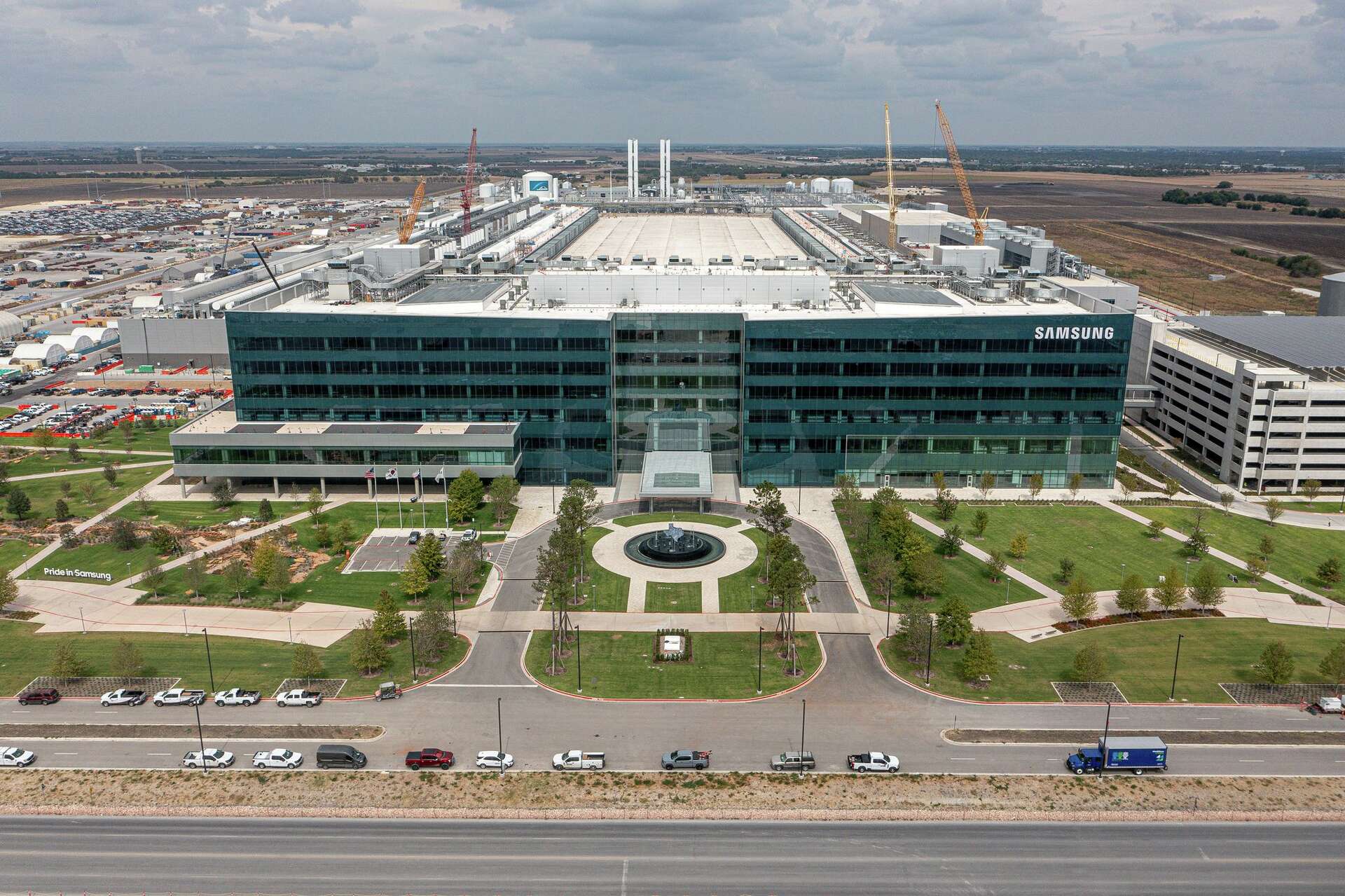

In its latest earnings call, Samsung Electronics officially confirmed that construction on its second Taylor fab (Fab 2) will break ground by late 2026, with target operations slated for 2030. Meanwhile, its long-awaited first fab (Fab 1) is set to begin commercial chip production within the next few months.
For the Taylor mega-site, which briefly slowed its pace due to customer sourcing hurdles and delayed equipment installation, this announcement signals that one of the largest foreign direct investments in U.S. history is once again shifting into high gear.
The Backstory: Navigating Delays to Secure Next-Gen Tech Leadership
Located approximately 30 miles northeast of downtown Austin, Samsung’s Taylor campus marks the first time the tech giant has publicly committed to a definitive construction timeline for its second facility. The massive 1,200-acre site already features nearly 4 million square feet of completed infrastructure, including a six-story office complex, Fab 1, specialized supplier facilities, dedicated power substations, water treatment utilities, and logistics warehouses.

The upcoming Fab 2 is projected to span roughly 2.7 million square feet, matching the scale of the initial facility.
This milestone carries significant weight given the project’s complex trajectory. First announced in 2021 with an initial $17 billion commitment, the Taylor expansion was originally slated for a 2024 rollout. However, inflation in construction costs, broader macroeconomic supply chain cycles, and the timing of federal CHIPS Act subsidies pushed initial timelines back.
More strategically, Samsung made a high-stakes decision during the pause: skipping the planned 4-nanometer node to leap directly into advanced 2-nanometer process technology. Designed specifically to power complex AI workloads, this technological jump required extensive process verification and recalibration of extreme ultraviolet (EUV) lithography tools.

While partial shutdowns over the past year raised external speculation, the temporary slowdown proved to be a calibration phase rather than a retreat. Earlier this year, Samsung secured the Temporary Certificate of Occupancy (TCO) for Fab 1 and completed trial runs for key machinery. With Fab 1 entering production and Fab 2 officially breaking ground this year, Taylor has decisively transitioned from setup to execution.
Anchored by Tesla: The $16.5B AI Megadeal
A pivotal turning point for the Taylor campus arrived via an anchor agreement with Tesla. In 2025, Tesla secured a landmark chip supply agreement with Samsung valued at approximately $16.5 billion through 2033. Elon Musk subsequently confirmed that Samsung’s Taylor facilities will produce Tesla’s next-generation AI6 chips—the hardware powering full self-driving (FSD) fleets and Optimus humanoid robotics, with volume production targeted for 2027.
This contract provides crucial demand visibility for Fab 1 while strengthening the economic justification for Fab 2. Driven by AI data centers, autonomous transport, and high-performance computing, Samsung posted over $62 billion in quarterly operating profit, a massive surge reflecting tight global supply for advanced chips. The restarting of Taylor’s expansion directly responds to this structural deficit.
The Greater Austin Vision: Regional Economic Impact
Samsung’s footprint in Central Texas extends far beyond these two fabs. In tandem with a $4.7 billion direct subsidy agreement under the U.S. CHIPS Act, Samsung plans to invest upwards of $37 billion across the region. The broader master plan envisions two advanced logic fabs, an R&D facility in Taylor, and expansion of its existing North Austin facility.
The full momentum of this ecosystem is poised to generate multi-layered economic tailwinds across Greater Austin:
- Solidifying the Semiconductor Hub: Continued expansion cements Austin’s position as a national nexus for advanced manufacturing, AI hardware, and semiconductor R&D.
- Job Creation & Supply Chain Inflow: On-site employment at Taylor is projected to reach 1,500 by year-end, pulling specialized equipment suppliers, materials vendors, and technical services into the immediate orbit.
- Powering the NE Austin Growth Corridor: The project strengthens infrastructure and economic connectivity linking Taylor, Hutto, Round Rock, and Austin, generating sustained demand for regional commercial space, housing, and operational land.

Strategic Positioning: Real International’s GT48 Project
Capitalizing on this industrial shift, Real International features an exclusive Industrial Outdoor Storage (IOS) project—GT48—located directly within the prime operational radius of the Samsung Taylor campus. Positioned along the SH-130 corridor with direct access to major arterials (bypassing I-35 congestion), GT48 is ideally situated to capture overflow demand for logistics, equipment staging, and operational support generated by Central Texas’s advanced manufacturing expansion.
📍 To learn more about the GT48 IOS opportunity or to discuss strategic investments along the Central Texas growth corridor, contact us today.