



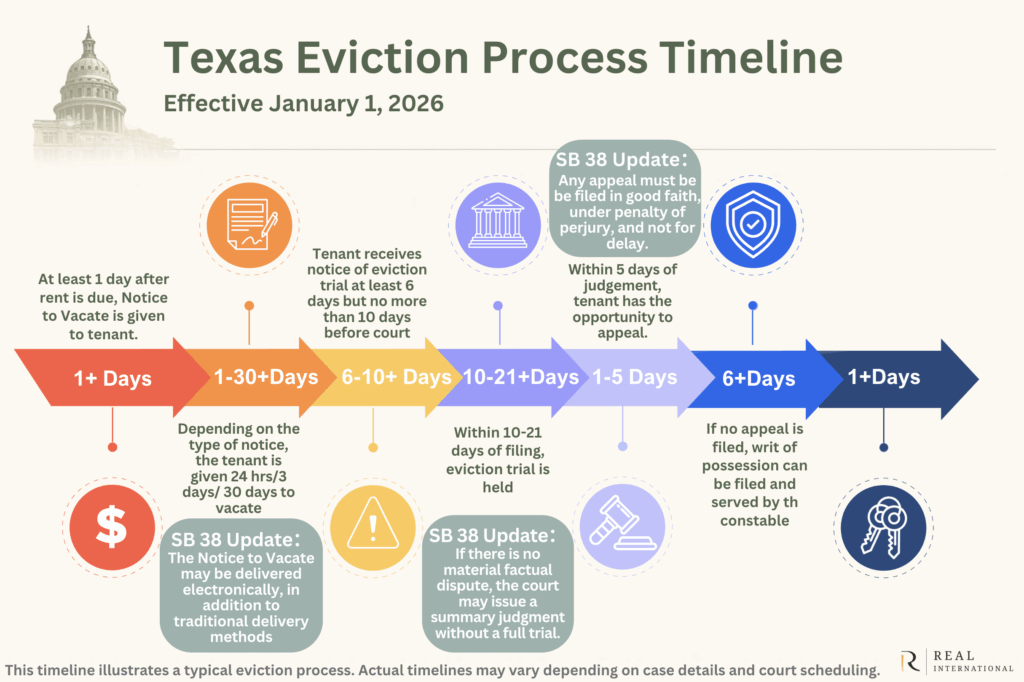
Starting January 1, 2026, a significant new law related to leasing and property rights officially takes effect in Texas: Senate Bill 38 (SB38). Signed by Governor Greg Abbott, it aims to streamline the eviction process and reduce procedural delays, making property ownership easier to enforce in practice.
For Texas landlords and real estate investors, this change could directly impact how quickly rental properties are handled in cases of unpaid rent, illegal occupancy, or lease violations. Faster resolution means more stable cash flow and smoother day-to-day operations.

Key Changes in SB 38
SB38 has been supported by the Texas Apartment Association (TAA), and one of its most important updates is the introduction of the summary judgment mechanism.
This allows courts to rule without a full trial in cases where the facts are clear and uncontested, such as obvious situations of nonpayment or unauthorized occupancy. This approach can significantly shorten the time between filing and final judgment.

At its core, SB 38 SB38 brings three major changes:
1. Faster case resolution.
When there is no substantial factual dispute, courts can make quicker decisions. This reduces delays within the system and provides a more predictable timeline for resolving rental disputes.
2. Stricter appeal requirements.
Tenants who appeal an eviction must declare under penalty of law that their appeal is made in good faith, not merely to delay proceedings. False statements could lead to penalties, which helps prevent unnecessary delays and uncertainty.
3. More flexible notice delivery.
In addition to traditional service methods, electronic delivery is now recognized as a valid option. This increases efficiency and makes it easier to keep clear records of notifications.
Why This Matters for Investors
In rental property operations, time itself is a cost. For long-term investors and landlords, the significance of SB 38 lies less in speed alone and more in predictability.
The risk of properties being tied up for months due to unpaid rent or squatting decreases.
Cash flow disruptions become easier to anticipate and manage.
Smaller landlords and individual investors may face less stress and administrative burden.
While these changes won’t alter the overall demand for rental housing, they will influence how landlords consider rent pricing, holding periods, and risk assessment.

Not everyone sees SB38 in the same light. Some argue that faster processes and electronic notifications could make it harder for certain tenants to fully understand or respond to legal procedures.
From an investment standpoint, however, SB 38 reflects a broader policy direction: Texas is prioritizing enforceability and clarity in property rights. The law does not expand the reasons for eviction; it narrows the ability for disputes to persist without substantive grounds.
In other words, the bill reallocates risk away from procedural uncertainty and toward clearer compliance standards.
The Bigger Signal Behind SB 38
SB 38 should not be viewed in isolation. It is part of a longer-term trend in Texas toward reinforcing owner protections and maintaining a business-friendly real estate environment.
It’s also worth noting that SB38 works in tandem with another law, SB1333, which takes effect in September 2025. SB1333 aims to speed up the handling of unlawful occupancy through criminal channels. Together, these two laws reinforce each other, each operating within its own legal framework but toward the same goal.
In a state with sustained population growth, strong rental demand, and ongoing housing pressure, legal certainty becomes a foundational investment variable, not a secondary concern.

SB38 won’t eliminate every rental risk, but it is reshaping how and when those risks arise. For landlords and investors, these adjustments will ultimately show up in project management, operations, and financial performance.
📍If you have questions about property investment or property management, feel free to reach out for more information.
📧 info@realinternational.com